Quantum-Safe Encryption Explained: Protecting Data in a Post-Quantum World
 pm_author_zK95y
Almost everything you do online depends on encryption. Bank logins, private messages, health records, and card payments all ride on the same math. A new kind of computer is being built that can unravel that math, and the fix has a name: quantum safe encryption. A 2025 ISACA survey of more than 2,600 professionals found that 62% expect quantum machines to break today’s encryption, yet only 5% work somewhere with a plan to respond. That distance between awareness and action is the real risk. The reassuring part is that the tools to close it already exist. Here is what the technology is, why it matters now, and how to start using it.
Key Takeaways
- Quantum safe encryption uses algorithms built to resist attacks from both classical and quantum computers.
- Quantum machines can break the public-key cryptography, such as RSA, that secures most of the internet.
- Attackers already harvest encrypted data now, aiming to decrypt it once quantum hardware arrives.
- NIST published the first quantum-resistant standards in 2024, and browsers already use them.
- A cryptographic inventory plus crypto-agility are the practical first steps toward adoption.
Quantum Safe Encryption, Defined
Quantum safe encryption is a family of cryptographic algorithms designed to withstand attacks from quantum computers while still running on the hardware you already own. It guards data by trading the math that quantum machines can crack for problems they cannot solve efficiently. For teams weighing their options, modern quantum safe encryption solutions are ready to deploy today rather than years from now.
The idea goes by a few names. You will see it written as post-quantum or quantum-resistant cryptography, and all three point to one goal: keeping information private even after powerful quantum computers exist. That goal is the next chapter in staying secure online.
|
Worth knowing: this technology does not require a quantum computer to run. It works on ordinary laptops, servers, and phones, which is exactly why the switch can begin right away. |
Why Today’s Encryption Is Living on Borrowed Time
Modern encryption leans on a small set of hard math problems. RSA and elliptic curve cryptography stay safe because classical computers cannot factor huge numbers or solve discrete logarithms in any reasonable time. A capable quantum computer, running Shor’s algorithm, could crack both within hours.
Symmetric encryption fares better. Ciphers such as AES face only Grover’s algorithm, which weakens them instead of defeating them, so longer keys restore their strength.
The catch is scale. The vulnerable algorithms sit inside browsers, payment systems, private networks, software updates, and countless devices, so replacing them is a multi-year effort rather than a quick patch.
|
Warning: the danger is not only future hardware. In a harvest now, decrypted later attack, adversaries copy encrypted data today and store it, ready to unlock the moment a capable machine exists. Anything meant to stay private for a decade is already exposed. |
The table below shows what survives the shift and what does not.
|
Encryption method |
Quantum safe today? |
Recommended action |
|
RSA |
No, broken by Shor’s algorithm |
Replace with ML-KEM |
|
Elliptic curve (ECC) |
No, broken by Shor’s algorithm |
Replace with ML-DSA |
|
Diffie-Hellman |
No, broken by Shor’s algorithm |
Replace with ML-KEM |
|
AES-256 |
Mostly, weakened by Grover |
Keep, use longer keys |
|
SHA-256 |
Mostly, mildly weakened |
Keep, favor larger digests |
Knowing which systems depend on the vulnerable algorithms is the groundwork for enterprise data protection systems that can adapt as standards change.
How Quantum Safe Encryption Actually Works
Quantum safe encryption trades fragile math for problems that even quantum computers struggle with. Most of the new standards are lattice-based, which means their security rests on the difficulty of finding short vectors inside high-dimensional grids, a task no known algorithm handles quickly. Lattice math has been studied for decades without a practical break, which is a big reason experts trust it to hold against quantum and classical attacks alike.
In August 2024, after an eight-year public competition that drew 82 submissions, NIST finalized the first three standards. They anchor the whole transition.
|
Standard |
Algorithm |
Purpose |
|
FIPS 203 |
ML-KEM (from CRYSTALS-Kyber) |
Quantum-safe key exchange and encryption |
|
FIPS 204 |
ML-DSA (from CRYSTALS-Dilithium) |
Primary digital signatures |
|
FIPS 205 |
SLH-DSA (from SPHINCS+) |
Backup hash-based signatures |
Two ideas make the move practical. Hybrid encryption runs a classical algorithm and a quantum-safe one side by side, so systems stay compatible during the change. Crypto-agility is the freedom to swap algorithms later without rebuilding an application from the ground up.
“Now is the time to migrate to new post-quantum encryption standards.” NIST, 2025
Governments echo that urgency. The White House has set 2035 as the target for federal systems to finish their move, and analysts expect current public-key encryption to be unsafe well before that date arrives.
Quantum Safe Encryption in the Real World
This is not a lab experiment waiting for launch. The technology is already shielding real traffic on devices you touch every day.
Major web browsers now negotiate post-quantum keys during secure connections. Apple added post-quantum protection to iMessage, and Signal secured its messaging earlier still, so billions of everyday chats already ride on the new math. Two of the largest internet infrastructure providers have set 2029 deadlines to secure their entire platforms.
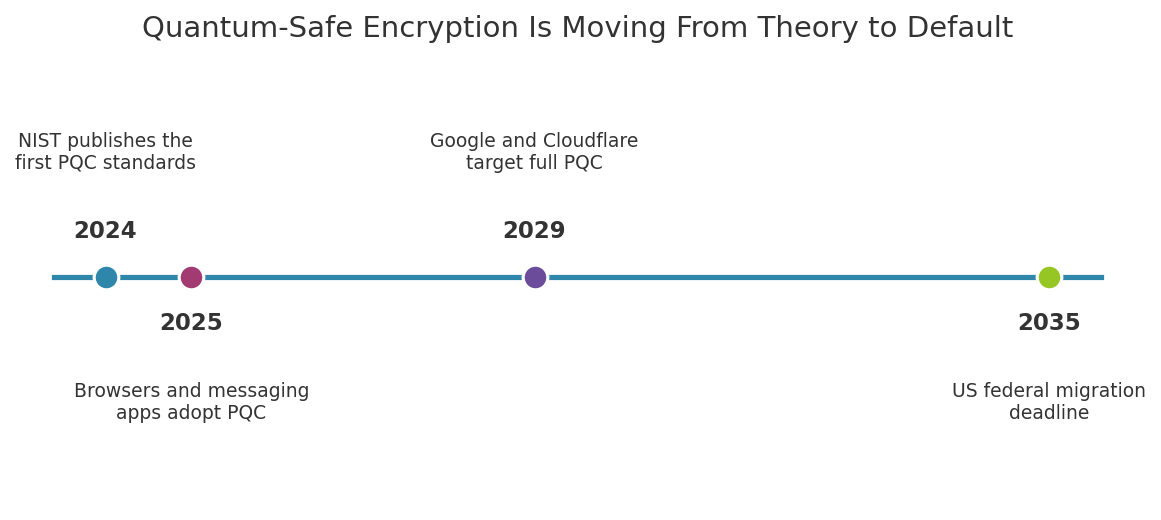
The shift is moving from published standards to everyday defaults.
Adoption on the open web has climbed fast. On one large global network, the share of everyday encrypted browsing using post-quantum key exchange leapt from a sliver in early 2024 to a clear majority by 2026.
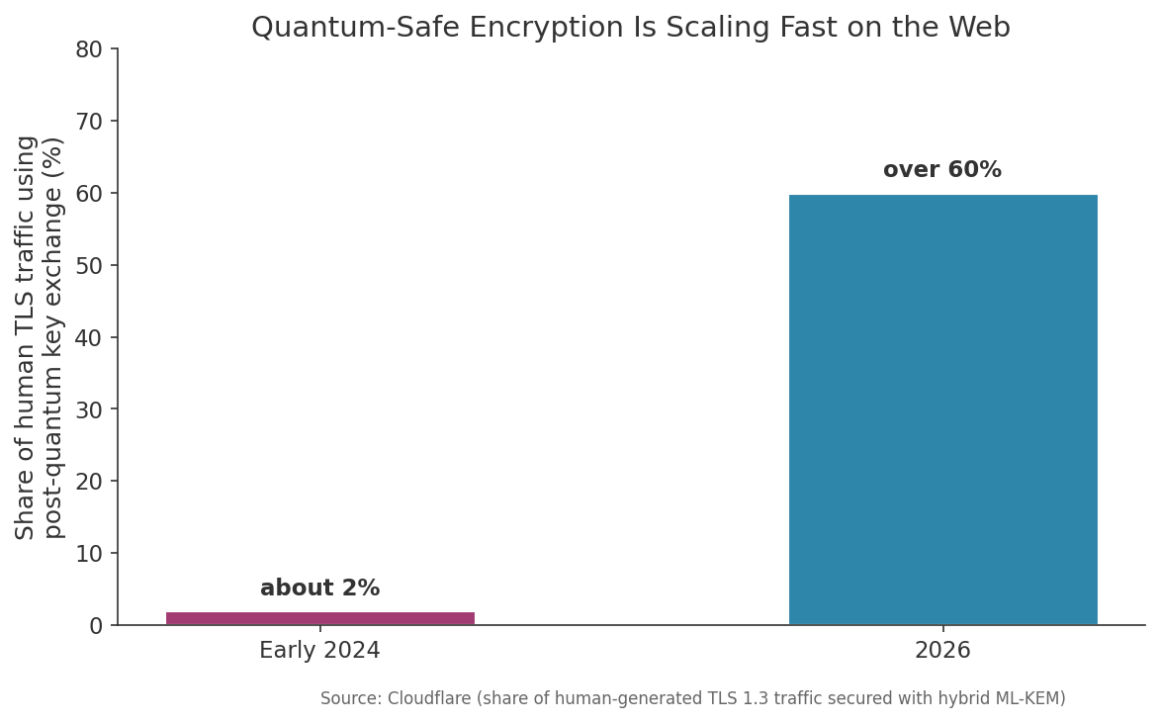
Post-quantum key exchange has gone from niche to mainstream in about two years.
For a structured way to follow that lead, national cybersecurity experts publish a hands-on migration playbook covering discovery, testing, and rollout. Weaving the same rigor into secure network infrastructure keeps the work grounded.
How to Adopt Quantum Safe Encryption
Preparation starts with visibility. A cryptographic inventory maps every place encryption lives, across websites, private networks, databases, apps, and outside services. You cannot protect what you have never mapped.
After that, rank the inventory by how long each dataset must stay confidential. Long-life, high-value information moves to the front, since it meets the harvest threat first.
|
Key stat: a late 2025 industry study found that 81% of security professionals believe their cryptographic tools and hardware are not yet ready for the switch, so most of this groundwork remains open. |
Practical moves worth starting now:
- Build and maintain a living cryptographic inventory across every environment.
- Classify data by how long it must remain secret, then protect the oldest first.
- Deploy hybrid encryption so nothing breaks during the transition period.
- Choose crypto-agile systems for anything new you build or purchase.
- Ask every critical vendor for a clear quantum-safe roadmap and timeline.
This talk from a working cryptographer explains the contest between code makers and code breakers in plain language. Good habits carry over as well: the discipline behind everyday data protection practices and dependable cloud security services makes a quantum-safe migration far smoother.
|
Pro tip: treat the switch as an ongoing program, not a one-off project. Fold it into existing security reviews so progress stays funded and tracked, and revisit the plan as the standards keep maturing. |
Frequently Asked Questions
What counts as quantum safe encryption?
It is a set of algorithms that hold up against quantum computers while running on ordinary hardware. The approach swaps vulnerable methods such as RSA for quantum-resistant standards that keep data private into the future.
Does quantum safe encryption equal post-quantum cryptography?
Yes. Quantum safe, post-quantum, and quantum-resistant cryptography all describe the same idea: encryption designed to withstand quantum attacks. NIST standardized the first such algorithms in 2024 for key exchange and digital signatures.
Can quantum computers break encryption today?
Not yet. No public quantum computer can crack strong encryption at this point. The concern is future hardware paired with data harvested today, where stolen files wait to be unlocked once capable machines exist.
Can I use quantum safe encryption already?
Yes. NIST’s standards are final, major browsers exchange post-quantum keys, and some messaging apps already protect chats with them. Organizations can begin deploying hybrid quantum-safe encryption across their own systems now.
How long does the migration take?
Plan for years. Encryption threads through apps, networks, and vendor links. Most government roadmaps target completion between 2030 and 2035, so an early cryptographic inventory keeps the whole effort manageable.
The Quantum Era Rewards Early Movers
The quantum era is not a far-off rumor. The encryption guarding your data today was never meant to survive it, and the migration ahead is measured in years. Quantum safe encryption gives you a proven route through, and the standards, browsers, and guidance are already in place. Organizations that inventory their cryptography, protect their longest-lived secrets, and build in the ability to change algorithms will move through the change with room to spare. Waiting only shortens the runway you have left.